How a Roof Inspector Reads Hail Damage in East Texas
Most hail damage is invisible from the driveway, so here's what happens when someone climbs up to find it.
October 13, 2026 · 4 min read
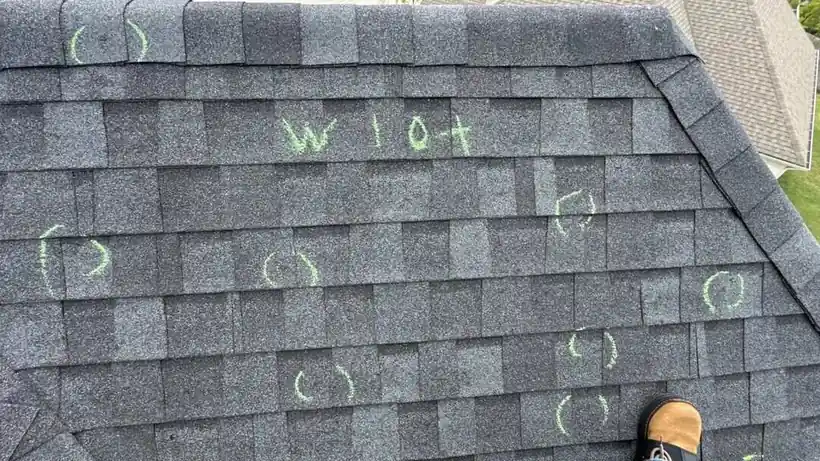
Stand in your yard after a hailstorm and your roof will probably look fine. That's the trap. Hail damage is usually small, spread across thousands of shingles, and sitting right on the surface where a pair of eyes at ground level can't read it. Steele Roofing says it plainly on its storm restoration page: sometimes roof damage is visible from the ground, but most of the time it isn't.
If you've ever wondered what an inspector is doing up there for half an hour, this is the short version.
Start with the clues on the ground
Before anyone climbs a ladder, the property itself tells a story. Hail doesn't pick favorites. If it dented one surface, it hit the rest of the house too, and the softer or more exposed things show it first. Walk the property and look at what's easier to read than shingles.
- Dents or dings in metal gutters and downspouts.
- Dimples in the roof of a parked car, or in an outdoor unit.
- Dings in vinyl siding, especially on the side that faced the wind.
- Damage to a deck, porch cover or patio awning.
- Piles of loose granules, the gritty black or gray stuff, collecting under downspouts.
- Tree branches that landed on the roof.
None of these prove the roof is damaged. They do tell an inspector which direction the storm came from and how hard it hit, and that decides where to look first.
What a hit looks like on a shingle
On an asphalt shingle, a hail hit usually isn't a hole. It's a bruise. The impact knocks granules loose and leaves a darker, slightly soft or dented spot, often about the size of the stone that landed. Where the granules are gone, the asphalt mat underneath is exposed to sun and water, and a shingle that's lost that protection ages far faster than the ones around it.
Sometimes the mat is cracked or fractured underneath, which you can only feel by pressing gently around the spot. Hail can also nick vents, turbines, flashing and ridge caps. That's why an inspector looks at more than the flat field of shingles: pipe boots, metal vents and the ridge line all take hits and all tell the same story.
Why you see chalk circles
If you've seen roofs with white circles drawn on them, you've seen an inspector's working notes. Hits are hard to spot once you step away, so the inspector circles each one with chalk, which makes the pattern readable and lets a photo show what a person saw. In Steele Roofing's own job photos you can see hail marked in chalk across shingles and along a ridge cap, with the neighborhood visible behind it.
The circles also keep things honest. When an adjuster or a second contractor looks at the same roof, they can see exactly what was counted and where.
The test square
Counting every single hit on a whole roof isn't practical, so inspectors commonly use a test square: a section, often ten feet by ten feet, on each slope. They count the hits inside it. A slope with a lot of hits in the square tells you the whole slope was hammered. A slope with almost none tells you something different.
How many hits it takes before a slope counts as damaged depends on the shingle and on your insurance policy, so we won't give you a number here. What matters is that the test square turns a vague feeling about the storm into something countable and photographed.
Cosmetic or functional
For insurance purposes, hail damage generally falls into two buckets. Cosmetic damage changes how the roof looks but not how it works, and it usually doesn't call for repairs. Functional damage means the shingle's ability to shed water has been compromised: cracked mats, exposed fiberglass, broken seals. A damaged shingle can't do its job, and it's a weak spot that tends to turn into a leak later.
Hail size matters, but not as much as people think. Stones range from pea size to baseball size, and bigger stones do more harm. Still, even smaller hail can damage shingles, particularly on an older roof. After the April 18, 2026 storm, Steele Roofing reported marble to quarter size hail across Tyler, Whitehouse and Noonday. Stones that size don't sound dramatic, yet they were enough to knock granules loose and leave impact marks on roofs they inspected.
What you should do after a storm
- Stay off the roof. Wet shingles, loose debris and weakened decking make it dangerous.
- Walk the property from the ground and take photos and video of anything dented or broken.
- Call your insurance company, and call a local roofer for an inspection.
- Don't start repairs before the adjuster has seen the roof if you plan to file a claim.
- Ask for the findings in writing.
That last one is how Steele Roofing works. The company provides a written assessment after every inspection, and the inspection itself is free. It usually takes somewhere between thirty minutes and an hour, and you don't have to be home while it happens. If the photos and notes show functional damage, you'll have documentation to go with a claim. If they don't, you'll know that too, and you won't be sold a roof you don't need.
Had hail come through your neighborhood? Call Steele Roofing at (903) 630-5751 for a free roof inspection and a written assessment of what's actually up there.
Steele Roofing LLC, (903) 630-5751
Call (903) 630-5751More articles
Filing a Roof Insurance Claim in Texas With a Contractor on Your Side
A roof claim feels confusing mostly because nobody explains the order things happen in.
Class 4 Shingles or a Metal Roof for Tyler Hail?
Both options fight hail better than a standard shingle, but they do it in different ways.